From: MARIS STELLA HIGH SCHOOL, Secondary 4 Preliminary Examination 2, PAPER 1 MULTIPLE CHOICE, NO. 22, 18th September 2008
A girl of height 1.6m stands 0.5m in front of a vertical plane mirror. What is the minimum length of the mirror which will the girl to see the whole of herself?
A) 0.5m
B) 0.8m
C) 1.3m
D) 1.6m
Solutions:
The minimum length of the mirror is obtained based on the following assumptions.
- The eye is right at the top of the head.
- The mirror is placed with its top at eye level, that is, same level as the top of the girl's head.
- The girl has normal good eyesight.
- Sufficient light intensity.
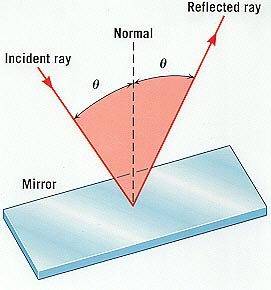
 PICTURE: http://faculty.etsu.edu/gardnerr/einstein/e-reflection.jpg
According to Laws of reflection
The incident ray, the reflected ray and the normal at the point of incidence all lie on the same plane.
The angle of incidence, i, is equal to the angle of reflection, r.
- The angle of incidence, i, is the angle between the incident ray and the normal.
- The angle of reflection, r, is the angle between the reflected ray and the normal.
- The normal is the perpendicular line to the reflecting plane.
If the length of the mirror is shorter, then the angle of incidence ray of the toe will be too great causing the reflected ray to be above the eye and thus not seen by the girl.
The answer is B) 0.8m
Source: http://www.physicsclassroom.com/class/refln/u13l2d.cfm
What Portion of a Mirror is Required?
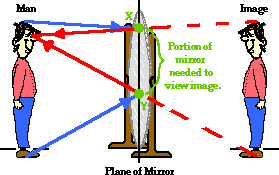
Ray diagrams can be used to determine where a person must sight along a mirror in order to see an image of him/herself. As such, ray diagrams can be used to determine what portion of a plane mirror must be used in order to view an image. The diagram below depicts a 6-foot tall man standing in front of a plane mirror. To see the image of his feet, he must sight along a line towards his feet; and to see the image of the top of his head, he must sight along a line towards the top of his head. The ray diagram depicts these lines of sight and the complete path of light from his extremities to the mirror and to the eye. In order to view his image, the man must look as low as point Y (to see his feet) and as high as point X (to see the tip of his head). The man only needs the portion of mirror extending between points X and Y in order to view his entire image. All other portions of the mirror are useless to the task of this man viewing his own image.
 PICTURE: http://www.physicsclassroom.com/class/refln/u13l2d1.gif
The diagram depicts some important information about plane mirrors. Using a cm-ruler, measure the height of the man (the vertical arrow) on the computer screen and measure the distance between points X and Y. What do you notice? The man is twice as tall as the distance between points X and Y. In other words, to view an image of yourself in a plane mirror, you will need an amount of mirror equal to one-half of your height. A 6-foot tall man needs 3-feet of mirror (positioned properly) in order to view his entire image.
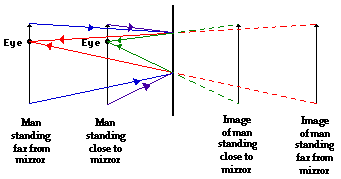
But what if the man stood a different distance from the mirror? Wouldn't that cause the man to need a different amount of mirror to view his image? Maybe less mirror would be required in such an instance? These questions can be explored with the help of another ray diagram. The diagram below depicts a man standing different distances from a plane mirror. Ray diagrams for each situation (standing close and standing far away) are drawn. To assist in distinguishing between the two ray diagrams, they have been color coded. Red and blue light rays have been used for the situation in which the man is standing far away. Green and purple light rays have been used for the situation in which the man is standing close to the mirror.
 PICTURE: http://www.physicsclassroom.com/class/refln/u13l2d2.gif
The two ray diagrams above demonstrate that the distance which a person stands from the mirror will not affect the amount of mirror which the person needs to see their image. Indeed in the diagram, the man's line of sight crosses the mirror at the same locations. A 6-foot tall man needs 3-feet of mirror to view his whole image regardless of where he is standing. In fact, the man needs the exact same 3-feet of mirror.
A common Physics lab involves using a tall plane mirror to explore the relationship between object height and the portion of mirror needed to view an image. A student stands a few meters from a planer mirror and views her image. With the student standing upright and still and staring at her feet, the lab partner moves a marker up and down the mirror until the sight location on the mirror is identified. The partner then marks this location on the mirror with an erasable marker. The process is repeated for the student staring at the tip of her head. Of course, being a lab, the procedure is subject to a variety of procedural and measurement error which may yield less than ideal results. The mirrors are occasionally mounted on a wall which is not perfectly vertical. Or a student will lean forward a slight amount, thus reducing his/her effective height. Or the mirror warps over the years leading to one which concave or convex rather than planar. Despite these potential complications, the 1:2 ratio between portion of mirror required to view the image and the height of the object is often observed.
Reference